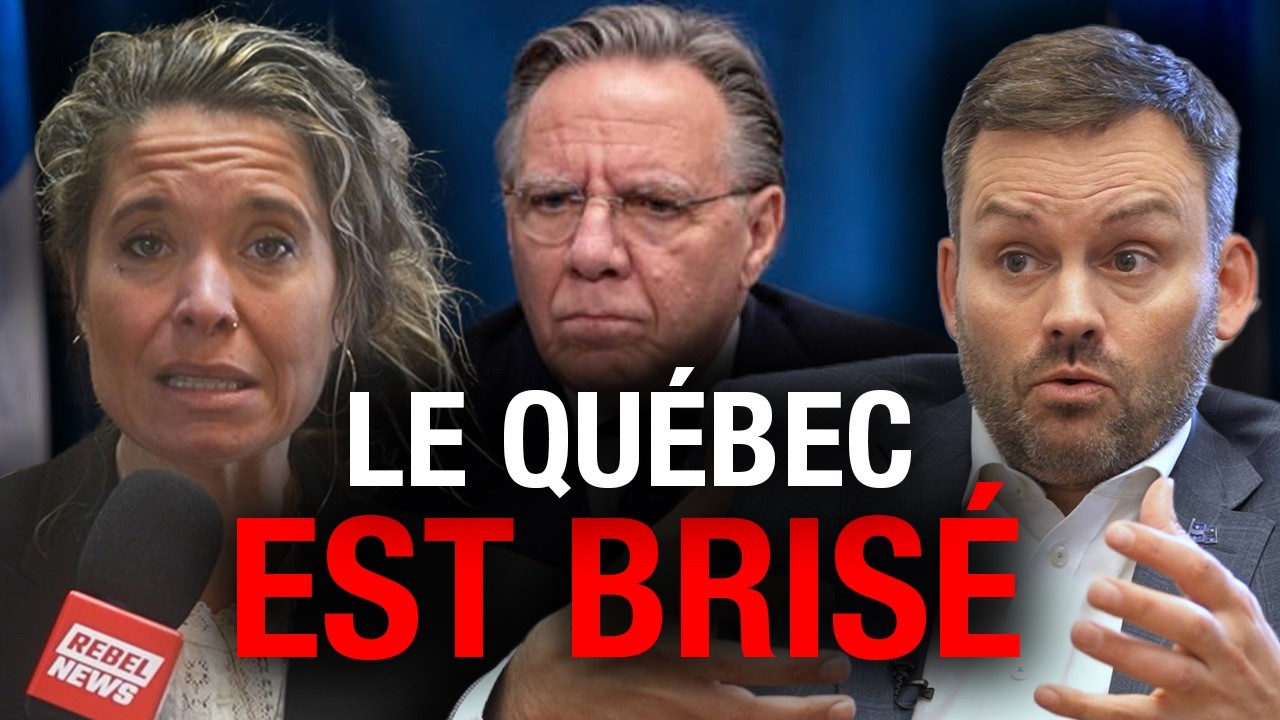
In the wood-panelled corridors of Quebec’s National Assembly, Paul Saint-Pierre Plamondon is a man who speaks as if the future has already been decided. The leader of the Parti Québécois (PQ), whose party has seen a dramatic resurgence in recent polling, is no longer merely talking about independence as a romantic dream of the past; he is pitching it as a “law-and-order” necessity for the future.
In an extensive interview with Rebel News Québec, Mr Plamondon—known widely as PSPP—laid out a calculated vision for a sovereign state that looks less like a revolutionary break and more like a rigorous “de-bureaucratisation” of the North American status quo.
The ‘asphyxiation’ of federalism
At the heart of Mr Plamondon’s argument is what he describes as the “fiscal asphyxiation” of Quebec within the Canadian federation. He contends that the province is currently being strangled by a “redundant” federal bureaucracy that doubles up on services already provided by the provincial government.
“We are sending 50% of our taxes to a system that doesn’t work for us,” he argued. His strategy is one of cold pragmatism: by repatriating those funds, a sovereign Quebec could bridge its healthcare and education deficits without imposing further taxes on a population facing an “inverted demographic pyramid.”
Secularism and the ‘public peace’
The most striking moments of the exchange concerned the delicate balance between religious freedom and the neutrality of the state. Mr Plamondon, positioning himself as the guardian of Quebec’s “Quiet Revolution” values, signalled a zero-tolerance approach to street prayers, which he characterised as “political gestures” designed to test state authority.
He dismissed the idea that this hardline stance was a fringe position, pointing instead to a mandate that has unified his political base:
“Within the Parti Québécois, this isn’t a divided issue. We have a 90% internal party consensus on this. Our members are clear: if you want a public peace that lasts, the state must remain neutral, and the public square must remain secular.”
Armed with this internal mandate, Mr Plamondon is bracing for what he calls a “head-on collision” with the Canadian legal framework—a system he claims prioritises individual religious expression over the collective right of Quebecers to a secular public space.
The Alberta question
In a move that may raise eyebrows in Ottawa, Mr Plamondon expressed a degree of admiration for Alberta’s assertive resistance to federal immigration mandates. He signalled a hardline shift regarding foreign nationals, suggesting that temporary residents who participate in protests inciting hate or “glorifying terrorism” should face immediate deportation.
He condemned the federal oversight of the border as “broken,” citing a systemic failure to track or remove individuals with expired permits. For the PQ leader, control over the border is not just a matter of sovereignty, but of basic social order.
A society ‘over-medicated’
When the conversation turned to healthcare, Mr Plamondon steered clear of the “magic solutions” often promised by his rivals. He identified the root of the crisis as a profound decline in the physical and mental health of the population.
Highlighting Quebec’s status as a leader in antidepressant and pediatric medication prescriptions, he argued that no healthcare model could withstand a society that is increasingly sedentary and “over-medicated.” He further dismissed the province’s reliance on private nursing agencies as a “fiasco” that merely shuffles existing staff at a premium to the taxpayer.
Hydro-power and sovereignty
On energy, his stance remains resolutely protectionist. He flatly rejected shale gas extraction and fracking, doubling down on a “Hydro-first” policy. For Mr Plamondon, energy independence via Hydro-Québec is a prerequisite for political sovereignty, aiming to insulate the province from the volatility of global oil markets.
The big picture
Mr Plamondon’s performance was that of a leader already measuring the drapes of the Premier’s office. He is successfully threading a difficult needle: maintaining his “progressive” credentials on social safety nets while adopting a “law-and-order” stance on identity and borders.
By framing the federal government as both an ideological and financial anchor, the leader of the PQ is attempting to rebrand the separatist movement for a new generation—not as a risky constitutional leap, but as a pragmatic path to a more efficient, orderly state. Whether this coalition of the pragmatic can survive the heat of a general election campaign remains the defining question for Quebec’s political future.